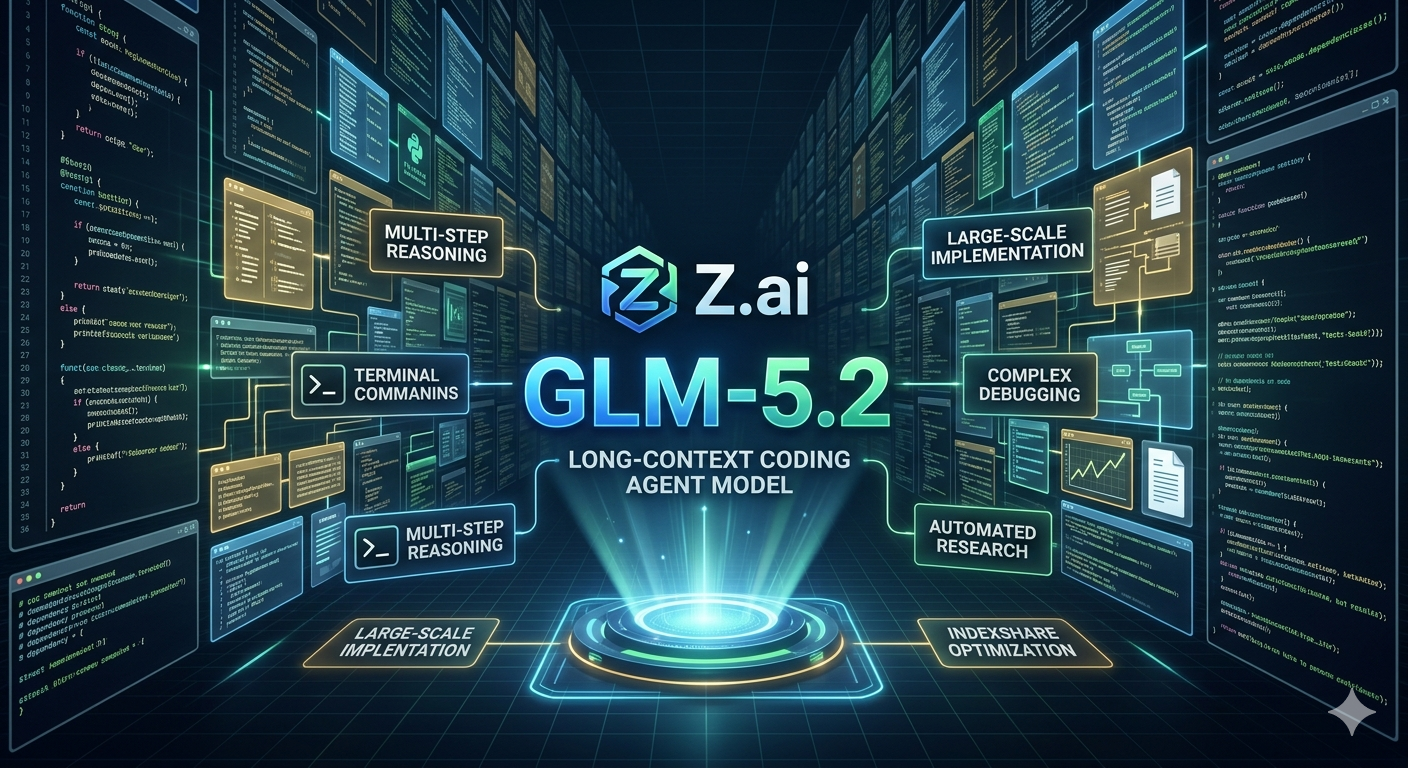
According to Z.ai, GLM-5.2 was created to perform multi-step reasoning and to ease software-engineering work that demands long-term planning.
A one-million-token context built for project-level engineering
A one-million-token context is significant not merely for processing lengthy instructions, but because it makes it possible to reason about an entire project-level engineering task within a single context.
This allows developers to feed in large codebases, technical documentation, test results, and work history together for processing. That capability is especially important for the development of large software projects that span many files.
GLM-5.2 can also process related documentation, tool output, and code changes together. Such a capability is a distinct advantage for AI coding agents that move between many actions — writing code, using the command line, running tests, and detecting errors.
According to the company, the model can be applied to a wide range of use cases, including writing code, conducting automated research, optimizing system performance, and detecting and fixing complex bugs.
New reasoning-level modes added
Compared with the previous GLM-5.1 release, GLM-5.2 not only improves task performance but also offers users two distinct reasoning-level modes.
These are:
High — a mode for quickly handling light and medium-difficulty tasks
Max — a mode that uses additional computation to solve more complex problems
This lets users choose the balance between speed and quality that best suits their needs.
Gains on benchmark tests
The benchmark figures published by Z.ai show that GLM-5.2 has made notable gains on engineering tasks involving code review, tool use, and the command line.
SWE-bench Pro
On SWE-bench Pro, which measures the ability to solve real-world software problems, GLM-5.2 scored 62.1. That is higher than the previous GLM-5.1 model's score of 58.4.
Terminal-Bench 2.1
On Terminal-Bench 2.1, which evaluates command-line tasks, GLM-5.2 scored 81.0 — a marked improvement over the previous version's 62.0.
The highest score in the test was 82.7, and GLM-5.2 came fairly close to that level. The company also reported that the model delivered competitive performance against some of the industry's leading models.
Reduced computational cost for long contexts
Z.ai set out to address, through architectural innovation, the problem that computational load rises sharply as context size grows.
The company introduced IndexShare technology, which reuses the same indexer across sparse-attention layers.
According to the company, IndexShare reduces the per-token computational load (FLOPs) by a factor of 2.9 when operating on contexts up to one million tokens long.
By also modifying the multi-token prediction layer, the company improved the efficiency of speculative decoding, increasing the accepted length by up to 20 percent.
These improvements have a meaningful effect in reducing the server and infrastructure costs that grow as codebases get larger.
Can be deployed on your own servers
According to the documentation published on Hugging Face, the GLM-5.2 model can be run on the following widely used platforms.
Transformers
vLLM
SGLang
Docker Model Runner
KTransformers
It can also be deployed on the Ascend NPU platform using the vLLM-Ascend, xLLM, and SGLang frameworks.
Because it carries an open-source license, organizations can run the model on their own servers and internal infrastructure, retaining full control over data security. This is one important advantage that sets it apart from closed models available only through cloud services.
Early developer reactions are positive
The launch of GLM-5.2 has begun to attract the attention of the international technology community.
Guillermo Rauch expressed a positive view of the model's coding capabilities through his social-media account.
Matt Velloso, after using it for a full day, was reported to have judged it "an open model you can rely on for everyday use."
Even so, the model's real-world success will depend heavily on independent developer testing and actual use in production environments.
Where the DeepSeek R1 model previously drew industry attention with its high-level reasoning ability and relatively low cost, GLM-5.2 emerges as a new competitor focused on coding and long-horizon engineering tasks.
At a time when competition among open-source AI models is intensifying, GLM-5.2 is beginning to be named as one of the most compelling new models aimed at large-scale codebases and project-level development.