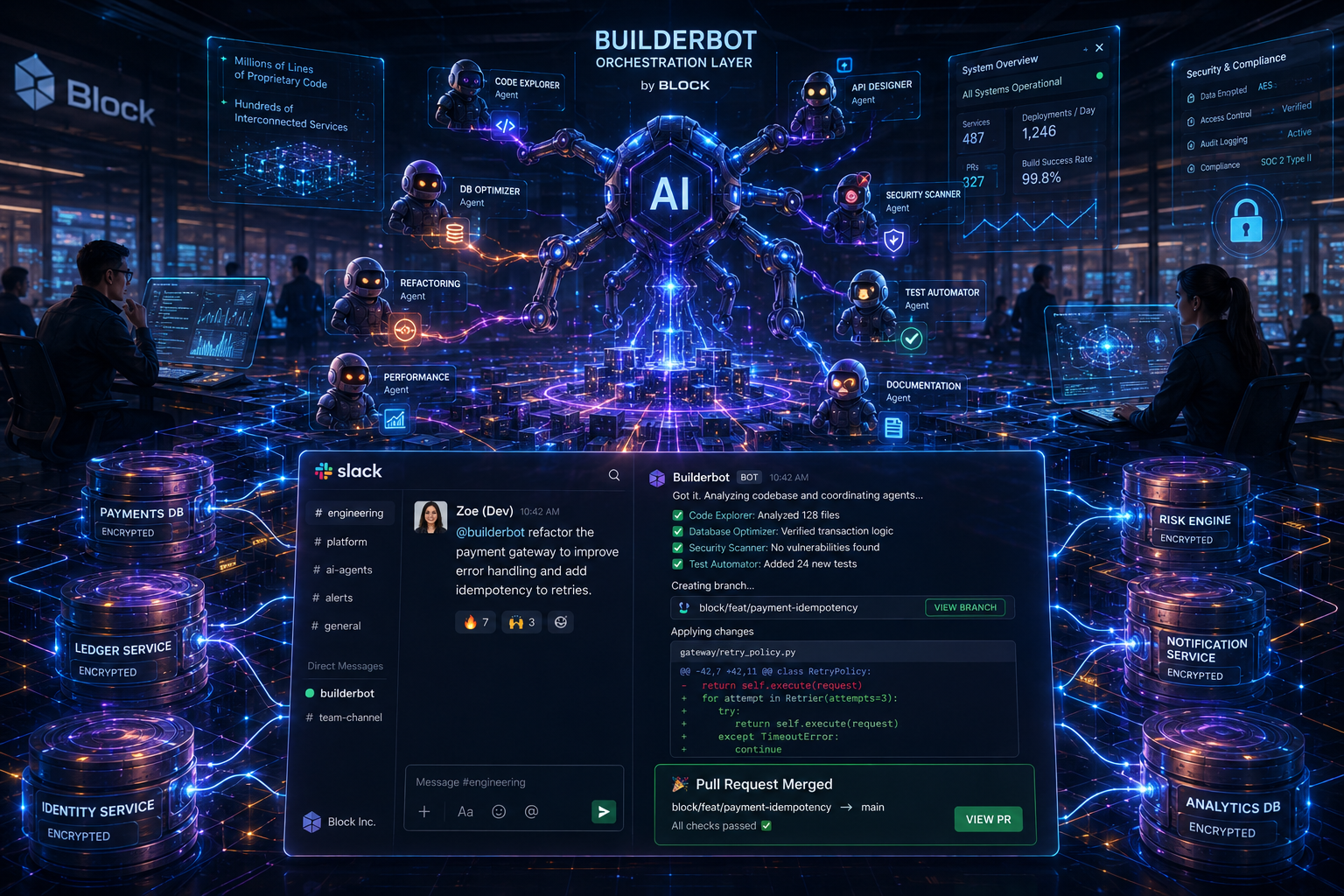
Technology giant Block (formerly Square) has announced the rollout of Builderbot, an artificial-intelligence (AI) agent framework designed to automate complex cross-service tasks across its entire software codebase.
Over the past 24 months, Block's engineers have thoroughly overhauled their internal development pipeline. By investing heavily in deeply integrating AI into the daily work of all engineering staff, the company's engineers now actively use these internal tools in their programming work.
Builderbot: a solution to complexity
As the AI tools were being rolled out, it quickly became clear that ordinary coding assistants built for a single repository were limited in an enterprise-scale environment. Working with hundreds of interconnected live services and hundreds of millions of lines of proprietary company code called for a more powerful solution. Block designed Builderbot specifically to remove the obstacles to mass adoption and to ensure real cross-system performance.
Builderbot operates as a centralized, highly active orchestration layer. To manage technically complex tasks across the infrastructure, the software coordinates a large number of separate software agents.
A workflow driven from Slack
Engineers activate Builderbot directly through the Slack communication channel. A developer simply tags @builderbot and writes a brief description of the required technical action. The agent begins processing the request directly within that chat thread. Requests can differ dramatically in structure, from simple bug fixes to major architectural migrations spanning many internal databases.
The entire platform-engineering collaboration takes place on the core communication platform. Several team members can review the agent's research and planning stages simultaneously, and, if needed, provide direction to correct the machine's execution trajectory. The chat thread effectively replaces the IDE (integrated development environment) interface, so developers no longer need to switch between team chat and external coding applications (the "cognitive penalty").
Builderbot's autonomous operation
Builderbot comprehensively maps the structural context of the company's entire codebase, cataloguing live network services, internal API endpoints, and strict engineering rules.
The agent has the digital permissions and contextual understanding needed to modify any software repository the company manages. For example, a software engineer in the Cash App division can request an operational change directly to a Square backend service. Because the centralized orchestration layer automatically supplies the correct architectural context, no prior experience with the Square subsystem is required of the developer.
Builderbot is also deeply integrated with task-tracking and project-management systems. It actively picks up assigned tickets from the Linear and Jira interfaces, creates a code branch, and generates the source code. The system then opens a formal "pull request" to validate the changes it has made to the network.
The workflow remains fully autonomous, and the system continuously monitors the automated continuous-integration (CI) test suite. Builderbot processes test failures or technical feedback from humans and iteratively refines the code until it meets the standard for production deployment. Human engineers do not write code by hand during this process; they take part only in high-level analytical decision-making.
Data security and results
Block designed Builderbot to operate solely within the scope of source-code repositories and system configuration. The network architecture strictly prohibits the agent from reading, processing, or transmitting users' raw data. Most importantly, it has no technical means of accessing the payment or personal information stored on production servers.
Active-usage metrics confirm the results of this strategy. The centralized integration layer successfully executes more than 200,000 separate operational commands every day. The automated system merges roughly 1,500 pull requests into the production codebase each week.
These autonomous code contributions account for about 15 percent of all structural changes made across the company's network. Since the system went live, the product-development cycle has improved dramatically, with initial project timelines shrinking from months to a matter of days.
Leadership's perspective and the technological foundation
Brad Axen, head of Block's AI capability office, said: "You can think of Builderbot as the 'missing layer' between AI coding tools and the real work of engineering. It handles the orchestration, context, and environment, so our engineers can focus on the problems that actually need solving," adding, "For Square, we took a list of features merchants had been waiting on for more than a month, and our engineers shipped them within a few days. Builderbot handled the groundwork, and the engineers made the decisions that shaped the product. That means the time to take an idea from plan to millions of users is now measured in days, not months."
This proprietary orchestration layer rests on an open technology foundation. Block built this internal system using its own open-source goose agentic framework. The company first developed goose internally and later donated its source code to the Agentic AI Foundation.
The technical challenges encountered in rolling goose out across the internal network led to an external industry partnership. The struggle to integrate the internal platform became the motivation for working directly with Anthropic. Block and Anthropic jointly developed the Model Context Protocol (MCP) to solve the problem of internal data connectivity. The resulting technology is becoming the industry-standard mechanism for connecting autonomous agents to internal development tools and raw data sources.
The company places importance on the technical transition to the next stage of coding, and it aims to publish detailed information on this and to contribute to technological progress.